
ISO 15025
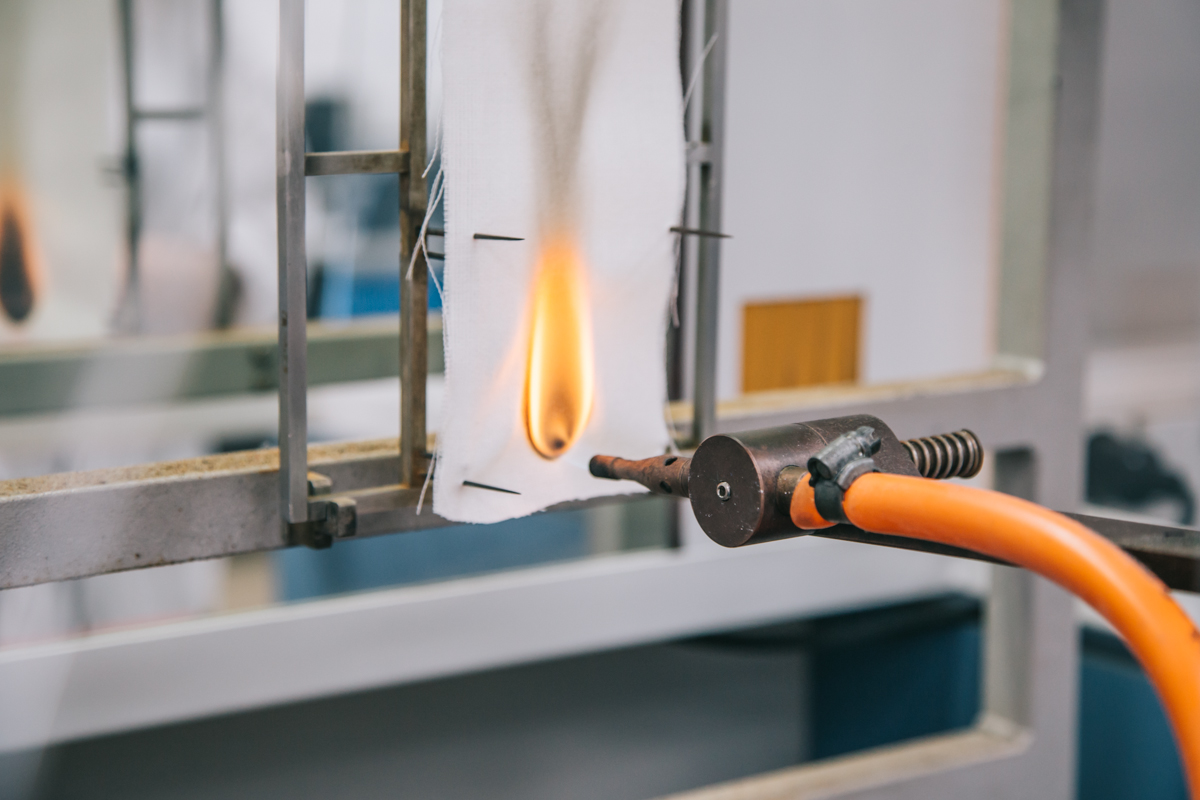
Applies flame for 10 s using surface and edge ignition, before and after cleaning.
Afterflame and afterglow ≤ 2 s. Edge-ignition char length ≤ 100 mm; no flaming or molten debris. Surface ignition also checks holes and seam integrity.

Protective clothing for wildland firefighting
ISO 15384 covers clothing for wildland firefighting and associated work, combining thermal protection, strength and physiological performance.
Applies flame for 10 s using surface and edge ignition, before and after cleaning.
Afterflame and afterglow ≤ 2 s. Edge-ignition char length ≤ 100 mm; no flaming or molten debris. Surface ignition also checks holes and seam integrity.
Measures radiant heat transfer using Method B at 20 kW/m², before and after cleaning.
RHTI24 ≥ 11 s and RHTI24 − RHTI12 ≥ 4 s.
Exposes clothing materials to 260 ± 5 °C for 5 min after cleaning. Protected hardware and visibility components have separate 180 °C requirements.
No melting, dripping or ignition; shrinkage ≤ 10%.
Measures tensile, tear and main seam strength of woven outer material after cleaning.
Minimum strength in N.
| Property | Method | Minimum |
|---|---|---|
| Fabric tensile strength | ISO 13934-1 | 600 N in each direction |
| Woven fabric tear force | ISO 13937-2 | 25 N in each direction |
| Main seam strength | ISO 13935-2 | 300 N |
Measures resistance to Martindale abrasion after cleaning.
At least 20,000 rubs at 12 kPa under Amendment 1.
Measures thermal resistance and water-vapor resistance of the material or combination.
Maximum Rct and Ret values.
| Quantity | Maximum |
|---|---|
| Thermal resistance Rct | 0.055 m²·K/W |
| Water-vapor resistance Ret | 10 m²·Pa/W |
Measures length and width change after cleaning.
Within ±3% for woven materials and ±5% for knitted materials.
Tell us about the workplace hazard, garment requirements and target certification. Our technical team will help you define the right solution.
